
Robots in companies, the best friends of the workers
They call them anthropomorphic and collaborative and they work alongside humans in many areas. At Faberlab of Confartigianato the robots are protagonists of the ABB
An anthropomorphic robot, meaning vertical, that draws and paints a ceramic tile, is the best summary of what the factory 4.0 is: the will and creativity of man combined with the precision of the machine. The natural objection which an artist would raise, could be the lack of errors that would render that piece unique. For the entrepreneur, however, the added value could be in the repetitiveness and fidelity of serial gesture included with the “artistic” product or even better, craftsman.
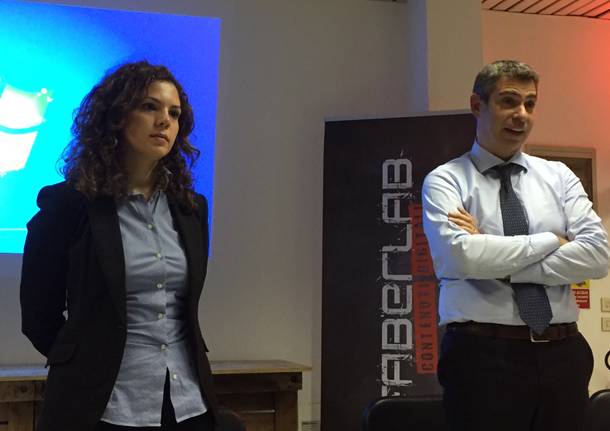
“The robot is a valuable ally of production,” explains Michael Pedretti, Manager of the ABB Swedish multinational world leader in the field of robotics, “is a tireless worker, accurate, robust, fast, versatile, long-lasting and easy to use.”
Pedretti, who spoke at Faberlab of Tradate to introduce entrepreneurs to Confartigianato the protagonists of the fourth industrial revolution, lists one by one the good reasons for doing this cultural leap: one increases the production capacity, reduces costs, improves the quality of the process, increases the production flexibility, reduces wastage, reduces the production spaces, and one reduces the fixed costs and above all improves the quality of work of the employees.
“Industrial robots in recent years,” continues the manager, “have evolved and have become easier to manage, easier to program and more secure.”
The example is YuMi, the newest member of ABB, a collaborative robot presented, incidentally, at the last fair in Hannover , Germany where five years ago it sat off the first spark of the new industrial revolution. “YuMi has a cost that is around 50 thousand euro,” says Pedretti, “and has been designed not only for the ROI of Central European companies.”
That of ABB manager is anything, except a joke. In fact, the applications of the new generations of robots seem cut out for the sectors that characterise the small companies of the Italian districts: from automotive to machine tools, from food and beverage to ceramics, from plastic-rubber to electronics, to the smelter and forge.
The basic objection is: what will remain of the working class? After losing their place in heaven, do they risk losing the job too? “In fact,” concludes Pedretti, “the robots have revitalised workings that were not made any more, like, for example, rifle butts, which were made by workers manually.”
Perhaps the real revolution is also semantic and lies in the word “collaborative“. Robots and human beings, no longer separated by cages and security perimeters, but placed next to one another “allied” in the production. The next step will be Cyborgs in the production? If this reminds you of a tale of Asimov (“I, Robot”), we are not so far from that.


TAG ARTICOLO
Dalla Home

Varese
Un minuto di silenzio nelle scuole per le vittime di Crans Montana. L’istituto Einaudi piange anche Giorgio

Verbania
Si perde e accende il fuoco: denunciata turista per l’incendio boschivo di Crevoladossola

Basket
Veljko Mrsic: “Quando Varese gioca in casa, la partita non è mai finita”

Malpensa
Niente viaggio nella terra di Babbo Natale: salta il volo Malpensa – Rovaniemi, duecento persone a terra
La community di VareseNews
Loro ne fanno già parte
Ultimi commenti
Felice su Niente viaggio nella terra di Babbo Natale: salta il volo Malpensa - Rovaniemi, duecento persone a terra
Felice su Capodanno, il Comune di Varese pubblica l'ordinanza che vieta botti, petardi e fuochi d’artificio
MannyC su Polveri sottili in riduzione in quasi tutta la Lombardia, Varese guida la classifica virtuosa di Legambiente
lenny54 su Il richiamo alla pace e ai valori della Repubblica nel discorso del Presidente Sergio Mattarella
giro su Capodanno, il Comune di Varese pubblica l'ordinanza che vieta botti, petardi e fuochi d’artificio
Felice su Amazon sospende le consegne con i droni in Italia







Accedi o registrati per commentare questo articolo.
L'email è richiesta ma non verrà mostrata ai visitatori. Il contenuto di questo commento esprime il pensiero dell'autore e non rappresenta la linea editoriale di VareseNews.it, che rimane autonoma e indipendente. I messaggi inclusi nei commenti non sono testi giornalistici, ma post inviati dai singoli lettori che possono essere automaticamente pubblicati senza filtro preventivo. I commenti che includano uno o più link a siti esterni verranno rimossi in automatico dal sistema.