
“The Congo will give us our children. We can wait.”
Mara Gorini, one of the 24 Italian mothers who returned to Italy without their adopted children, is strong and determined. “Sifa will be coming, I’m sure. This story will have a happy ending.”
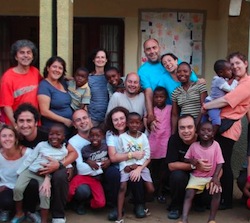 Mara Gorini is one of the 24 Italian mothers who came home without their adopted children; the government of the Democratic Republic of Congo decided not to let the children leave, until they had made further checks on the applications for adoption already started, and on those already approved. For this reason, little 3-year-old Sifa (see photo, right), has remained in Africa, while her adoptive mum and dad are waiting, in Sumirago, Italy, for things to get moving again. Mara’s husband, Matteo Galbiati , will be coming home, to Caidate, in the next few hours, but the little girl will be staying in the centre, in Kinshasa, that was home to her new family (mum, dad, and two little brothers aged 7 and 10) for two long months. We asked Mara Gorini, the Councillor for Social and Education Policy, to tell us what life is like in this situation which is full of stress and unknowns. We found a strong women with a solid faith, who was positive about the future.
Please start by telling us who you are and why you chose to adopt your daughter from the Congo.
“My husband and I have been married for 14 years. We have two other adopted children, one from Italy and the other, from Vietnam, aged 10 and 7. So, we aren’t inexperienced. We went through a long procedure to be accepted as adoptive parents; one of the strengths of the Italian system, one of the best in the world on this matter, is the protection of the children through a careful selection of potential parents. We didn’t choose the country of adoption, the authorities did, on the basis of two principles: the level of cooperation and a check of the real state of abandonment of the children being adopted. We placed our trust in the non-profit association Enzo B, through whom we adopted our second son in Vietnam. We placed no restrictions on the country. The Congo, a country that has been in the international adoption circuit for years, where the association has been working since 2008, was suggested to us, and we accepted.”
How long did it take to start the application?
“Almost 2 years. For each adoption, you have to start from the beginning, and that’s how it should be. Little Sifa was allocated to us in November 2012, but we agreed with the association that followed us and with the international adoption committee to wait for the Congo to confirm the procedure. After twelve months, they gave us the go-ahead to collect her, and on 4 November, we set off with our two sons, who were with us all the time.”
But when you arrived in the Congo, the first problems started …
“We knew that the Congo had stopped international adoptions for one year, a legitimate choice that a sovereign State had taken to protect its people. Our papers had already been authorised, so we went to Kinshasa with great confidence. The first two weeks, we were optimistic, but then the first doubts arose, and we finally realised that the signatures would not be added to the children’s permits.”
Where did you stay in Kinshasa? And where will the girl be staying until the conclusion (which we hope is positive and quick)?
“We stayed in a religious centre that let out rooms. We couldn’t leave the centre, the men went once a day to buy food, and we stayed inside with the families, in a place that respected the privacy of each family. We were the only ones with two other children, but there was always a peaceful and quiet atmosphere.”
When did you understand that something wasn’t working?
“At end of November, when the stalemate started. Then we began contacting the embassy and the Ministry, until Christmas, when the prospect of a quick solution vanished. We were advised to return to Italy and to leave the children in the Congo, and we reluctantly agreed. The Congolese authorities allowed us to choose where to leave our children: Sifa is in the same centre where we stayed in those months.”
You were in Africa with your other two children. What was the situation like for them?
“They were mature about it, even though they’re small. When it was suggested we should return home, they both said that they didn’t want to go without their little sister. One evening, after they’d had a short discussion, they came to us and said, “We’ll stay here with Sifa, even if it’s hard.” How lovely! When we were “forced” to come back, we did it gently; the children and I came back on 31 December, and my husband will be back very soon, so as not to leave Sifa suddenly all alone.”
How was the return?
“The first few days were hard. It wasn’t the return that we had dreamed of or imagined. We’re trying to get back to a suspended “normality”, without desperation, living day by day, with joy. My children seem calm, they’re slowly getting their space back. I’m going back to work soon; when my husband returns, he’ll have to reinvent his job: he runs an agency; he’ll need a little time to get back on track.”
You appear to have great inner strength, which has undoubtedly helped you, and continues to help you to see things in a positive light, and to stay full of hope …
“Matteo and I both have a strong belief in God. We had it before, we have now and we’ll have it tomorrow. Our faith isn’t a crutch that helps us at times of difficulty, but a certainty that we take with us. At moments of difficulty, we like to spend time and experience it with more beauty, goodness and truth, among ourselves and with our friends. Our real friends understand the situation and my needs: a few words, a pot of pasta, and the demonstration of a feeling that requires simple things. Sifa will be coming, this story is going to end, and end happily, I’m sure of it. There’s the unknown of this hard time we have to bear, but I have no doubt.”
You’ve started up a collection of funds to help the children and the structures where they are housed. Who had the idea?
“It was my idea; a lot of people asked me what they could do to help us. The only thing, in addition to believing in the goodness of the work of diplomacy, is a concrete gesture; in the Congo, they need everything, to ensure that our children live better, carefree, we need the help of many.”
Here are the details for anyone that would like to make a donation
Banca Prossima
IBAN IT38X0335901600100000003660
made out to: Associazione Enzo B Onlus, Via O. Vigliani 104, 10135 Torino
Reason for the donation: "UN AIUTO ALLE CONGO FAMIGLIE”



Dalla Home

Castronno
In cucina tradizione e libertà devono convivere con buon senso: Rapanello e la sua ricetta

Varese
Varese “terra dell’outdoor”, dalla palestra alla vetta in un solo orizzonte

Olimpiadi
Un po’ di Varese sul podio olimpico: argento e bronzo per le atlete del Giappone “adottate” dall’Acinque Ice Arena

Legnano
Salmo torna a Legnano: a luglio live sul palco del Rugby Sound
La community di VareseNews
Loro ne fanno già parte
Ultimi commenti
Simone su Lavori in autostrada A8 a Gallarate, per otto mesi carreggiata per Milano ridotta a due corsie
Stefania Radman su Apre il cantiere stradale in via Carcano a Varese che rivoluzionerà la viabilità di Biumo
GrandeFratello su Apre il cantiere stradale in via Carcano a Varese che rivoluzionerà la viabilità di Biumo
GrandeFratello su Apre il cantiere stradale in via Carcano a Varese che rivoluzionerà la viabilità di Biumo
Francesco Enrico Speroni su Scuole Materne di Gallarate, scontro sulle rette e sulla “clausola aperta”
Giorgio Stucchi su Scuole Materne di Gallarate, scontro sulle rette e sulla “clausola aperta”






Accedi o registrati per commentare questo articolo.
L'email è richiesta ma non verrà mostrata ai visitatori. Il contenuto di questo commento esprime il pensiero dell'autore e non rappresenta la linea editoriale di VareseNews.it, che rimane autonoma e indipendente. I messaggi inclusi nei commenti non sono testi giornalistici, ma post inviati dai singoli lettori che possono essere automaticamente pubblicati senza filtro preventivo. I commenti che includano uno o più link a siti esterni verranno rimossi in automatico dal sistema.