
“I have Goldrake as a friend”
The former Mayor of Cazzago Brabbia has published the first part of an “encyclopaedic” work: the story of Japanese robots, from their origins to the 1970s. And in April, the real story of the robot that revolutionised Italian television will be published.
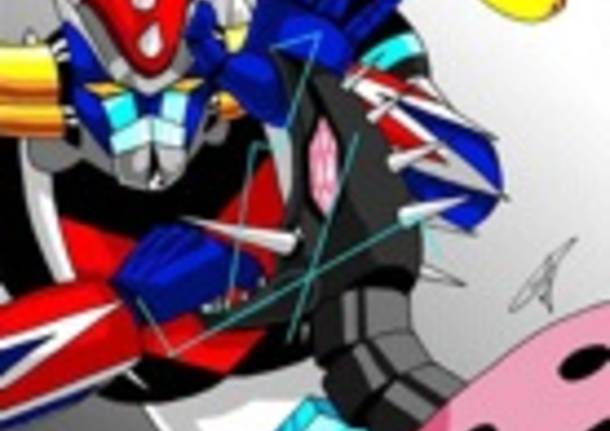
The first clear memory of his long adventure with Goldrake is in a house by the sea, in winter. His relatives are in the kitchen, eating supper, in the company of the priest of Cazzago, and he, a child, in his bedroom, sitting on his bed eating plain rice, in front of a black and white television, watching the adventures of his Japanese hero.
Four decades have passed since then, and Massimo Nicora has done many things: he graduated in theoretical philosophy, he married Jeanna, a beautiful woman from Belarus, he worked in the communication sector, in an agency in Varese, which, among other things, dealt with video games, home video and animation. For ten years, he was the Mayor of Cazzago Brabbia, the village that is home to his heart and his family, and that he leaves only when he has to, taking with him a tiny suitcase, to be sure he will be back soon.
In spite of this, Goldrake was always there, beside him, in a corner, until one day, about ten years ago, they met again. And what happened is astonishing. Massimo Nicora decided to tell the story of Mazinga, Goldrake, Jeeg and all of the Japanese manga, including the TV series. The result is an immense book of almost one thousand pages, which has been divided into several volumes.
The first volume came out a few days ago. C’era una volta… prima di Mazinga e Goldrake. Storia dei robot giapponesi dalle origini agli anni Settanta (Once upon a time… before Mazinga and Goldrake. The story of the Japanese robots, from their origins, until the 1970s) (186 pages, published by Youcanprint Edizioni, €16). In April, C’era una volta Goldrake. La vera storia del robot che ha rivoluzionato la tv Italiana (Once upon a time… there was Goldrake. The true story of the robot that revolutionised Italian television), the work that gave rise to everything, will be in bookshops.
“I spent months and years, consulting books in English, leafing through newspapers and publications of every kind,” the former Mayor of Cazzago Brabbia explained. “Summers spent leafing through volumes and searching the internet for material scattered around the world.”
And every time, here and there, fans of Japanese robots and of Goldrake appeared, happy to help him write the book.
“It may be difficult to understand but mine isn’t only the story of Japanese cartoons; I tried to do a sociological study and explain the philosophy behind these characters.”
The bibliography is truly notable, and this makes the books of Nicora a unique and complete work. All of the magazines specialised in manga, comics and video games contain an article dedicated to the first book, an almost unexpected success.
“Not everyone knows that Goldrake, and Godzilla, with their strength and their impetuousness, their strong legs trampling the ground and shaking the cities, are monsters fighting the atomic bomb; it’s a way of exorcising what happened in Hiroshima and Nagasaki.”
But how did we get to Mazinga, Goldrake and the “giants” of the Japanese cartoons?
“Telling the story of the Japanese robots means taking a long journey between reality and fantasy, from the first robots created by skilful artisans during the Tokugawa era, which was from 1600 to the second half of the 1800s, to the most modern production of manga, anime and TV series, in a storm of ideas that marked an era and the imaginations of more than one generation. Before the more famous characters in the cartoons, there were a lot of other robots, often famous, sometimes unknown, who won over the general public. This contains their story.”
It is pointless to say that Massimo Nicora has seen every kind of Japanese cartoon, he has the whole Goldrake collection, but he also looked in the newspaper libraries for articles from the 1970s and 1980s that spoke about the robot invasion of the television screens. “The left-wing newspapers demonised them, the right-wing ones glorified them; they portrayed the victory of the hero, of strength, of legend.”
The summary of “C’era una volta…” speaks for itself: Manga and the proletariat, the Manga go to war, Japan and the Second World War, ontological problems and a plurality of messages, Doraemon: the imagination has the power, are just a few examples.
The book seeks to provide answers to a series of questions on the origin of a Japanese passion that later “colonised” half of the world.
Previews of the next book, the one entirely dedicated to Goldrake, can be found on Massimo Nicora’s blog, C’era una volta Goldrake.
The book is selling really well among the fans of robots and Japanese culture, of technology and art. But deep down, it is a book for everyone, because it is also a little bit of our story.


Dalla Home
Somma Lombardo
L’incomprensibile stallo del centrodestra a Somma Lombardo

Varese
Ex Aermacchi, nuova demolizione nell’area: modifiche alla viabilità in zona

Scuola
Iscrizioni a scuola: uno studente su due sceglie il liceo. A settembre 900 alunni in meno in prima superiore

Basket
Si riaccendono le “Luci a Masnago”: parliamo di tattica con coach Matteo Jemoli
La community di VareseNews
Loro ne fanno già parte
Ultimi commenti
Bustocco-71 su Come si capisce una guerra, giorno dopo giorno
Felice su Come si capisce una guerra, giorno dopo giorno
ClaudioCerfoglia su Come si capisce una guerra, giorno dopo giorno
anselmo piazza su Lavori in Viale Belforte, Via Marzorati e Via dei Campigli: a Varese senso unico alternato dal 24 al 30 agosto
Bustocco-71 su Cede la rampa della tangenziale, deviazioni tra Malnate e Varese
GianPix su Il varesino Marco Iemmi ha vinto il Premio Internazionale "Il Poeta dell'Anno"







Accedi o registrati per commentare questo articolo.
L'email è richiesta ma non verrà mostrata ai visitatori. Il contenuto di questo commento esprime il pensiero dell'autore e non rappresenta la linea editoriale di VareseNews.it, che rimane autonoma e indipendente. I messaggi inclusi nei commenti non sono testi giornalistici, ma post inviati dai singoli lettori che possono essere automaticamente pubblicati senza filtro preventivo. I commenti che includano uno o più link a siti esterni verranno rimossi in automatico dal sistema.