
The app has eaten my desk
The approach to planning office space has been called into question for a while. The office of the future is a hub that must encourage creative collaboration, reinforce the sense of identity and the creation of meaning. It is a system that is complementary to, and integrated with remote working.
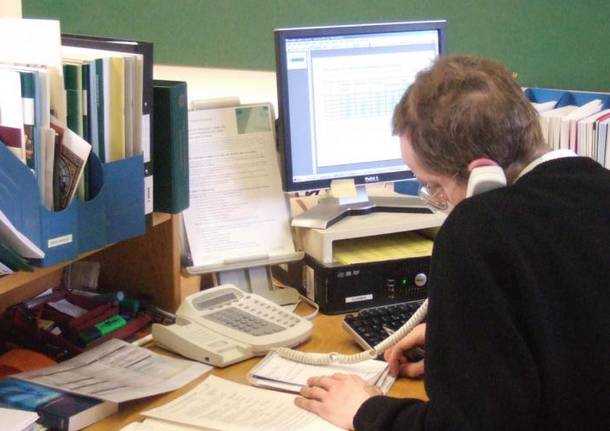
What can we do when the app says that all of the workstations in the office are occupied? This possible scenario disturbs the sleep of those who have to decide on the density in the office space. The ratio between the number of workstations and the number of people entitled to use them is one of the key variables in space planning.
For years, it was not a relevant issue for most organisations because the equivalence of 1 workstation = 1 head was always true. Indeed, in employment contracts, having a job has always meant also having a place, that is usually clearly identified, in which to sit and work. Over the years, some organisations (first consulting and technology companies, then banks and then other sectors) have started to question this paradigm, without this becoming the norm. I remember the fear in a large organisation which, after endless studies on the advisability of going down to a 90% ratio (9 workstations for 10 people), decided to continue with 100%: it was not worth the risk.
With the pandemic, everything changed: 100% was not enough to guarantee distancing and we went to 200% and more. One person every two desks, or three or even four empty ones. Maximum inefficiency to achieve the necessary safety.
Now, however, the wind is changing, and companies thirsting for efficiency are constantly on the lookout for opportunities, including, of course, so-called smart working, which is not so smart if it only involves working at home, or being forced to work at home, as it is not a choice. Thinking about the new normal, once the pandemic is over, it will be possible to increase the density in the office space; for many companies this will mean desk-sharing, the use of booking systems to ensure employees do not have to work from the break area, the reception rooms or the park benches, for those who have one. In these cases, the algorithms go crazy calculating how many workstations are really needed. In theory, it would be simple if we were robots. Two days working in the office, three days working from home, which means 60% of the workstations are free. In other words, still in theory, if you have 5 floors, you could free up 3 of them, as well as parking spaces, canteen spaces, cleaning, utilities, etc.
In practice, fortunately, life makes mathematics much more interesting. You have to calculate the human factor, which is a very special variable and at least as fickle as the weather. There are those who are not at all interested in working from home three days a week, let alone doing so on a regular and scheduled basis, those who have to be in the office for unavoidable service requirements, such as getting coffee eight times a day free of charge, with a sweetener of jokes and gossip, those who live alone or who do not live alone enough at home, who cannot wait to get to the office to be with someone or to be really alone, and those who belong to the 9% of companies that will force anyone that does not get vaccinated to work from home (see 2021 AIDP study). In addition to these extreme and realistic cases, there are all the strictly objective business needs that require a varying and irregular presence in the office, which cannot be regulated using perfect, but essentially useless formulas.
When the focus of work is collaborative efficiency (the speed with which a group solves a problem), physical proximity significantly increases productivity because its fuel is communication. And the fastest, lowest-cost, highest-bandwidth communication technology is still the office. Every true innovator knows that ideas come even in the shower, which is usually taken at home and alone, but they flourish and bear fruit following contamination by constructive criticism, which can only take place when there are people around. When interviewing a scientist and researcher on this question recently, I received this comment: “When you’re in the company of others, you can say stupid things, scribble on a napkin and pass it on to someone at lunch, to see what effect an absurd idea like cycling to Mars has on those you trust. It’s by playing with ideas together that forbidden combinations are created, ones that are prohibitive for Zoom‘s sterile connections. This is the only way to create truly revolutionary innovations; the rest is copy and paste, which even the Chinese don’t do any more.” This applies to research, marketing, and even administration that wants to create value; otherwise there’s outsourcing.
Companies that are redesigning new ways of working have understood this well: the office of the future will consist of one or more hubs designed to foster creative collaboration, strengthen a sense of identity and create meaning, a complementary system that integrates with remote working. This does not mean that we cannot push for space efficiency and there are many ways to achieve this while reducing the risk of alienating people who cannot find space.
First of all, the focus of the conversation needs to shift and the overall set-up needs to be assessed well. When we talk about smart working, we tend to be binary: working from home or working in the office. However, most organisations are likely to evolve towards a mix of 3 groups: people who can, because of their role, and prefer, because of their personal circumstances, to work almost exclusively remotely; people who, by their role and/or by choice, work almost exclusively in the office; and finally, a group that falls somewhere in between, working remotely and in the office, depending on personal preferences, the type of work they are doing on a given day, and other external factors. According to Gartner, the first group could account for about 10% of the workforce, the second, for 50% and the third, for about 30%. Everyone should do their own calculations and simulations.
From a practical point of view, in order to prevent the problem of congestion, it is good not to force but to direct people towards reference areas, in accordance with the function or work team; better still, to train collaborators to be a team, adopting all of those good habits that allow resources to be shared respectfully and efficiently. It is not necessary to book a workstation if I plan to be in meetings for most of the day in special rooms; it is better not to encourage booking a long time in advance, because priorities change and plans are adjusted on a weekly basis; it is good to offer large support spaces that cannot be booked, or colonised by so-called “outsiders”, that have been in the company for years, as an alternative solution to managing peaks in demand; it is good for bosses to set a good example, by behaving like everyone else, without official or unofficial privileges.
Lastly, a good space management system has an intrinsic degree of re-convertibility, as the result of a design and choice of furnishings that allow allocations and proximities to be reformulated to respond, at little cost, to changing needs, as they arise over time, of project teams, of integrations, of regulatory constraints, and so on. “An adaptive space, because the app is for the ordinary, but the algorithm does not favour the extraordinary,” as Methodos’s Elisabetta Peracino said.
Given this hybrid reality, organisations need to ensure they create a seamless experience for their workers that allows them to switch smoothly between remote and presence, without the experience being perceived as unsatisfactory or inconsistent and without negatively impacting diversity and advancement opportunities. For companies, it is therefore a good idea to establish new smart working policies, avoiding the danger of confining themselves to hyper-efficient spaces based solely on the concept of sharing reserved desks. It is better to transform the square metres freed up into new areas of value creation, for themselves and for their communities and stakeholders: customers, universities, partners, start-ups.
“Space said to time: I want more, and so there was the universe,” Manuel Mariani.
Translated by Sarah Guarneri, Denise Mura, Adriana Bocse, Chiara Brovelli
Reviewed by Prof. Rolf Cook


Dalla Home

Varese
Prevenzione e partecipazione: nasce a Varese “DesTEENazione”, il nuovo hub per gli adolescenti

Milano
Tassa salute per i frontalieri, bocciata la mozione del Pd che ne chiedeva abrogazione

Gallarate
Scuole materne Gallarate, “altro che fake news, mostrino il verbale con gli aumenti”

Golasecca
“Non sogni, ma progetti già avviati”: Rossella Bosco svela Golasecca InVita
La community di VareseNews
Loro ne fanno già parte
Ultimi commenti
lenny54 su Il professore che a Mosca ascoltava Putin viene a Varese spiegarci la guerra
principe.rosso su Il professore che a Mosca ascoltava Putin viene a Varese spiegarci la guerra
lenny54 su Il professore che a Mosca ascoltava Putin viene a Varese spiegarci la guerra
Felice su Il professore che a Mosca ascoltava Putin viene a Varese spiegarci la guerra
principe.rosso su Il professore che a Mosca ascoltava Putin viene a Varese spiegarci la guerra
Fabio Rocchi su Il professore che a Mosca ascoltava Putin viene a Varese spiegarci la guerra








Accedi o registrati per commentare questo articolo.
L'email è richiesta ma non verrà mostrata ai visitatori. Il contenuto di questo commento esprime il pensiero dell'autore e non rappresenta la linea editoriale di VareseNews.it, che rimane autonoma e indipendente. I messaggi inclusi nei commenti non sono testi giornalistici, ma post inviati dai singoli lettori che possono essere automaticamente pubblicati senza filtro preventivo. I commenti che includano uno o più link a siti esterni verranno rimossi in automatico dal sistema.