
“I emigrated out of love for mathematics”
Alessandro Chiesa left at the age of 17, and has studied at MIT (Massachusetts Institute of Technology) for 5 years. For the first time, he describes his experience, and the events that led to his involvement in a story about hackers.
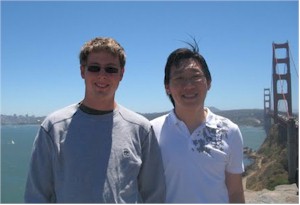 One year ago, he found himself at the centre of a legal matter that was being featured by the press in half of the United States. We followed the story of Alessandro Chiesa, who, together with three fellow students at the Massachusetts Institute of Technology (MIT), had found a fault in the ticketing system of the Boston Subway. The students spent an unpleasant quarter of an hour, and then came out winners.
We visited Alessandro in the halls of the prestigious MIT in Cambridge, a land oozing with culture and technology everywhere. Indeed, around Boston, there are 79 universities, including Harvard. There are more research institutes here than anywhere else. For anyone that has a passion for mathematics and computer science, MIT is legendary.
“And why not?” Alessandro replies calmly to the first question about why he is there.
He left Varese at the age of 17, after attending the European School. “That was an obvious choice for me, because my grandmother taught there for thirty years. When I finished the courses, I took an exam at an American school in Opera, near Milan, and I took and passed the admission test for MIT. It wasn’t so difficult; anyone can do it.”
That may be true, but you can count the Italians attending those courses on the fingers of one hand. “There are various reasons for this,” Alessandro continues. “We’re very attached to our mothers, but above all, we, too, have prestigious institutions. Just think of the Milan Polytechnic.”
In the meantime, Alessandro has obtained two degrees in Theoretical Mathematics and Computer Science and Engineering. For the second degree, he attended a number of courses in Chinese. He is currently attending a Masters in the Theory of Computation, and he is interested in the foundations of computer science, cryptography and algorithms.
What was it like coming here at the age of 17?
“It’s a different world, but I immediately felt at home. I live close to the university, and this helps resolve many problems. It’s not like in Italy; here, you fit in immediately, and you have lots of opportunities to study.”
Are you really convinced that anyone can come?
“Sure, if you want to. Of course, there’s the problem of the language, but once you’ve got over that, I don’t see any other problems. It takes a certain amount of creativity, a passion for studying and for what you do.”
What is your typical day like, and what do you do apart from studying?
“Before I suffered a slipped disk, I used to row. It’s a wonderful sport, from both a physical and a psychological point of view. It has a philosophy that instils discipline, to tolerate and to overcome every difficulty. In addition to this, it has also given me the chance to meet and compete with some great champions. This is something you would never find in Italy. In American universities, sport is linked a great deal to study. Apart from that, I’m not interested in free time. I’ve got a girlfriend, and we both love what we do here.”
What is the best thing here at MIT?
“The lecturers. They’re all brilliant and exceptional. Our courses are all free of charge and online, but what makes the difference is being here, breathing this air, interacting with the lecturers and the other students. There’s a sort of osmosis. Important projects are carried out here, and we can really do research.”
What plans do you have for the future?
“First to finish the Masters, and then to do my research doctorate over the next five years. We’re wondering whether we should stay here at MIT, or go to another campus. I’d like to work in research very much, but we’ll see …”
Apart from studying, have you ever worked?
“Yes, I’ve done a number of jobs, because we have three months during the summer, and several weeks’ break during the winter. I also used these breaks to spend some time in China and learn the language well.”
Don’t you miss Italy, and Varese?
“I miss the mountains and the lakes. More Switzerland than Varese. I’d like to go and live there rather than go back to a town.”
How did the clash with the Boston Subway Company come about?
“A lot of mistaken things have been said about that. We were never employed, but in the out of court agreement, the judge made us hand over the details of our work.”
But what happened?
“After years of work, the MBTA changed the ticketing system and introduced T-Charlie, a card with a magnetic strip from which it could be determined if the ticket was new. As part of an exam, we studied all of the mechanisms and discovered that there was a way to violate the protection.”
And what caused all the fuss?
“They had spent a huge amount of money, and they couldn’t accept the fact that students had broken their system. They’d been caught with their trousers down, and, instead of pulling them up, they got angry with us. Basically, it was easy, we were only kids studying at MIT.”
But why did the press feature it so prominently?
“Well, it was a very delicate matter. We informed the company that we would present the research at a conference on security, which is held every year in Las Vegas. This was part of our study work. No objection was made. Then, two days beforehand, they woke up and requested the judge stop our presentation. The judge called an adjournment for three days, and we couldn’t go to the conference. It was a serious matter because the reaction was out of all proportion, an order of this kind in the United States is given in very rare cases, because it goes against the first amendment and the freedom of research. What was the point of doing it, if we couldn’t make it public? It’s not only a question of principle, but a central element of US democracy. I think that this might become a dangerous precedent. That’s why it was given so much attention.”
And how did you feel?
“Bad, because we spent hours on the phone with lawyers, and we were worried. Then, fortunately, the matter was resolved.”
And how?
“The judge didn’t agree to their request for a five month injunction, and we collaborated by providing them with the procedures that put their security in danger.”
But is every computer system really in such danger?
“I’m interested in theoretical mathematics, and not particularly interested in security; but it’s clear that many companies prefer their own systems, developed by their own programmers. This way of working involves a few dozen people, at best. So, once they’ve been produced and put into operation, it only takes a few hours to break into them. Too few people test them and work on them. Companies spend huge amounts of money, convinced that this is the securest way of working, but it isn’t. If we consider open source systems, it’s all different because tens of thousands of people work on them, and everything is known about them, and so any development they make is more secure.”
What do people think of Italians here?
“There are too few of us, and we’re not well known, unlike Romanians, who are regarded as geniuses.”
And what advice would you give to “our” young people”?
“Come and study here.”



Dalla Home

Ciclismo
Il Cinghiale di Orino torna a casa dopo le vittorie in Cina e Turchia. E adesso tocca alla Danimarca
Editoriale
Fakir, Roggero e il rischio che corriamo

Varese
Blitz della Polizia contro la criminalità giovanile: tre arresti e oltre due chili di droga sequestrati a Varese

Cosa sarà Varese
Biumo Superiore, il borgo delle ville che si sente “abbandonato”: tra turisti, strade dissestate e il sogno di una piazza
La community di VareseNews
Loro ne fanno già parte
Ultimi commenti
principe.rosso su Varese, distrutto per la seconda volta lo striscione 'Restiamo Umani': la denuncia del Comitato per la Palestina
fracode su Varese, distrutto per la seconda volta lo striscione 'Restiamo Umani': la denuncia del Comitato per la Palestina
Stefano Montani su Varese, distrutto per la seconda volta lo striscione 'Restiamo Umani': la denuncia del Comitato per la Palestina
PaoloFilterfree su Giorgetti arriva a Sumirago e ribadisce lo spirito di Bossi: "Sapevamo da dove arrivavamo e dove volevamo andare"
VittorioCappuccio su Lago Maggiore, l'acqua arretra: caldo e siccità mettono sotto pressione il Verbano
Felice su Da Busto Arsizio a Milano per fare ricerca sul cancro: la storia di Francesca Peluso






Accedi o registrati per commentare questo articolo.
L'email è richiesta ma non verrà mostrata ai visitatori. Il contenuto di questo commento esprime il pensiero dell'autore e non rappresenta la linea editoriale di VareseNews.it, che rimane autonoma e indipendente. I messaggi inclusi nei commenti non sono testi giornalistici, ma post inviati dai singoli lettori che possono essere automaticamente pubblicati senza filtro preventivo. I commenti che includano uno o più link a siti esterni verranno rimossi in automatico dal sistema.