
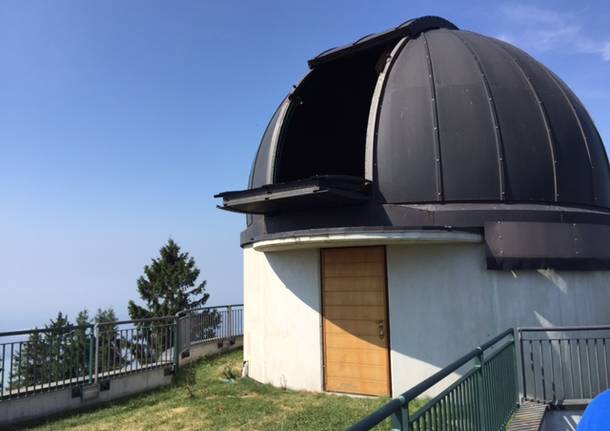
Space detritus “measured” by the Schiaparelli Observatory
The tests on the fragment that fell to Earth, on Friday, by experts at the Observatory, show that it might be a piece of the Apollo 10 mission, which set off in May 1969.
Last Friday, 13 November, at 7.18 a.m., Italian time, a fragment of space detritus, called WT1190F, re-entered the atmosphere off the coast of Sri Lanka.
The story of this object is rather interesting.
On 3 October 2015, the Astronomical Observatory “Catalina Sky Survey”, in Arizona, which is interested in the discovery of asteroids near the Earth, filmed what was thought to be a small asteroid.
After the initial observations, it seemed clear that the object in question did not orbit the Sun, like all asteroids, but in fact orbited the Earth. The orbital calculations described it as an artificial object, probably a piece of one of the space missions of years gone by.
As soon as the orbit was calculated with good precision, the object was associated with others that have been known since 2009 (9U01FF6, UDA34A3 and UW8551D), to show that, in fact, it was the same that periodically passed by the Earth. WT119OF was followed from that moment, and the experts calculated that it would eventually fall to Earth, on the morning of 13 November 2015.
Our Observatory did not miss the opportunity to watch it throughout its orbit, from its apogee (farthest point from Earth) to its perigee (nearest point).
The first image dates back to the night between 4 and 5 November, when it was about 598,000 km from the Earth. The weak dot tested our instruments to the limit, and to see it required a 40-minute exposure using the main telescope, which has a 60cm diameter. We observed WT1190F again, on 9 and 11 November, and of course, on the night before the impact.
The object could be seen from Italy, from midnight until less than an hour before it re-entered the atmosphere, and the operators (Luca Buzzi and his partner John Colombo) decided to dedicate most of their time observing it with the main telescope.
Right from the start, given the short distance (76,000 km around midnight), exposures of only one second were necessary, otherwise it would have been difficult to get precise orbital measurements.
The measurements sent during the night made possible to calculate the arrival coordinates even more precisely.
At around 4.30 a.m., Italian time, when it was less than two hours to impact, we tried to figure out if this object was rotating on itself, and to do this, we made individual exposures of 30 seconds. Already the first exposure led us to suspect that it could rotate very quickly, because the flight strip was actually consisted of a sequence of brighter and darker areas, which is an unmistakable sign that it was rotating.
The last picture was taken by us exactly 91 minutes before the impact with the Earth’s atmosphere, which as we’ve said, took place just off the coast of Sri Lanka. NASA experts, in conjunction with Arab scientists from the Space Agency of the United Arab Emirates, observed the re-entry into the atmosphere, on board a plane, because, on the ground, the sky was overcast; the mission was a success.
The obvious question that arises spontaneously is, “What is WT1190F?” At the moment, there is no definite answer. One of the possibilities examined by experts at INAF (our National Institute of Astrophysics), is that it is a piece of the Apollo 10 mission, of the lunar excursion module, known as “Snoopy”, to be precise. The Apollo 10 mission, which began in May 1969, had the task of trying to get close to landing on the moon, but without letting the module reach the surface, which would be achieved by the very famous Apollo 11, two months later, with the legendary module “Eagle”. After successfully attempting the manoeuver, Snoopy split into two. The descent module was made to crash into the Moon, and it was decided that the engines of the other module should be turned on to make it enter a particular solar orbit, in co-rotation with the Earth. But as stated, this is only a possibility.
The observations of WT1190F were very important, because, once more (the first time was with the asteroid 2008 TC3, which crashed in Sudan, in October 2008), it was possible to calculate the precise point of impact of a celestial body with the Earth, within a few kilometres, maybe even less. Knowing the precise coordinates of the impact, with advance warning, would allow us to put into action certain procedures in the event of a larger asteroid arriving. Of course, we hope there will never be the need …


Dalla Home

Malpensa
Salvini: “Il 25 settembre a Malpensa per l’intitolazione a Silvio Berlusconi”

Economia
L’innovazione europea a chilometro zero: il progetto “Open Mind Tour” fa tappa al JRC di Ispra

Cassano Magnago
Scontro tra due auto all’incrocio, una si ribalta e ne urta una in sosta: tre ferite a Cassano Magnago

Lavoro
Dalla tuta blu dell’Alfa Romeo alla Cgil nazionale, la lunga strada di Stefania Filetti
La community di VareseNews
Loro ne fanno già parte
Ultimi commenti
principe.rosso su Crollo alla E-Work Arena, Varese pronta ad aiutare la Uyba Volley: a disposizione il palasport di Masnago
GrandeFratello su Centro Campus, via alla trasformazione: "Varese sempre più all'avanguardia nel basket europeo"
lenny54 su Turisti e seconde case fanno impennare i consumi d'acqua nel nord della provincia, lo dicono i dati degli acquedotti
Felice su Musi di Varese 2027, presentato il calendario del Canile: Palazzo Estense accoglie i cani della città
Felice su Turisti e seconde case fanno impennare i consumi d'acqua nel nord della provincia, lo dicono i dati degli acquedotti
Bvroye su Nel lago di Monate avvistata la medusa d’acqua dolce: “Specie aliena ma non è periolosa”








Accedi o registrati per commentare questo articolo.
L'email è richiesta ma non verrà mostrata ai visitatori. Il contenuto di questo commento esprime il pensiero dell'autore e non rappresenta la linea editoriale di VareseNews.it, che rimane autonoma e indipendente. I messaggi inclusi nei commenti non sono testi giornalistici, ma post inviati dai singoli lettori che possono essere automaticamente pubblicati senza filtro preventivo. I commenti che includano uno o più link a siti esterni verranno rimossi in automatico dal sistema.