
The “Warrior Plant” exhibition at Villa Mirabello
Plants from all over the world, plus about thirty photographic stories. The exhibition will remain open until 8 May.
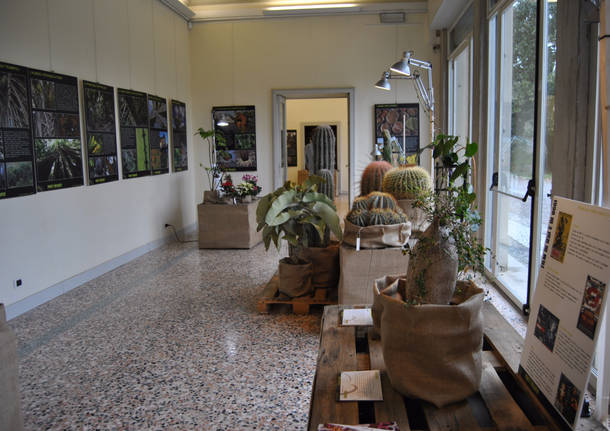
Vegetables that believe they are animals, plants that look like stones, plants that move and insects that camouflage themselves by taking on the appearance of flowers; the exhibition of “Warrior Plants” has come to town, and is the ideal follow-on to the exhibition “Predators of the Microcosm”, which, in 2015, brought over 5000 visitors to the Civic Museums in Varese.
The exhibition of “Warrior Plants” organised by Insubria University, in collaboration with Varese town council, is being hosted in the newly renovated spaces of the Civic Museums of Villa Mirabello, in Piazza della Motta 4, Varese, from 28 November 2015 to 8 May 2016.
The creators of the exhibition are Francesco Tomasinelli, a photojournalist and science writer, and the Association Pithekos of Milan, with the advice of Dr Marco Caccianiga, a researcher at the Department of Biosciences at Milan University. Prof Bruno Cerabolini, a lecturer in Environmental Botany at Insubria University, Prof Adriano Martinoli, a lecturer in Zoology at Insubria University, and Dr Serena Contini of the Civic Museums of Villa Mirabello are the organisers and scientific supervisors of the whole project. They have enabled full integration of the topics of the exhibition with the various events organised to complete the scientific and cultural journey.
This is the second time the exhibition has come to Italy, after Genoa, in 2014, during the Festival of Science.
The exhibition presents plants from all over the planet, genuine wonders of the plant kingdom, that have undergone very unusual adaptations to compete with other plants or to discourage any predators; it is no accident that the subtitle of the exhibition is “Plants that think they are animals”. In the strange greenhouse set up at the Civic Museums in Varese, it is possible to see, for example, carnivorous plants that use a variety of strategies to trap insects and small amphibians, in order to get the nitrogen necessary for their metabolisms, leaves that, thanks to sticky substances, fold suddenly, and even tube traps. There are poisonous plants on display, with a focus on house plants, which, unknown to their owners, often contain toxic molecules, such as the poinsettia, cyclamen and datura, that are potentially dangerous for humans and pets. Then cactuses and other succulents that dissuade herbivores, sheltered by an impenetrable barrier of thorns, or that camouflage themselves to look like rocks and stones, like the so-called “living stones”. One area is dedicated to orchids, which have evolved extraordinary shapes and colours to attract pollinating insects, and another to plants capable of movement, like the Mimosa pudica, which suddenly withdraws its leaves at the slightest touch. Finally, the most unusual seeds in the plant kingdom, that have adaptations that help them to scatter, from “winged” seeds, which exploit the wind, to those with thorns, which hook onto the fur of mammals, to those that can float in the ocean for years, are on display.
The exhibition also includes about thirty photographic stories on panels, and a number of terrariums with animal species, which, in the course of their evolution, have exploited plants to their advantage, such as the orchid mantis, which is shaped very similarly to the flower, and the moss frog, whose body is covered with green bumps that resemble moss.
There has also been important collaboration with the local nursery gardens and associations, such as Confagricultura and the Varese Association of Nursery Gardeners, who have set up their own areas; and the exhibition is sponsored by the Lombardy section of the Italian Botany Society.
The exhibition can be visited during the opening hours of the Museum (from Tuesday to Sunday, 9.30 a.m. – 12.30 p.m. and 2 p.m. – 6 p.m.), purchasing a normal admission ticket (€4 for adults, €2 for children). In addition to a programme of themed conferences, there will be guided tours and workshops for school groups and families, starting in January 2016, thanks to the contribution of a number of students on the Communication Science and Sciences of the Environment and of Nature courses at Insubria University, who, under the supervision of Prof Federico Pasquarè Mariotto, a lecturer in Science Communication, will carry out a training internship in preparation for their degree theses.
“This kind of initiative highlights the dual nature of the University; on the one hand, teaching, the quality of which is known and appreciated, and on the other, research. Indeed, the exhibition is linked to areas of study that have been the focus of our researchers for years, and it becomes a way to make the results of these studies intended to conserve biodiversity ‘tangible’ and comprehensible, even to non-experts,” said the Rector, Prof Alberto Coen Porisini.
“Thanks once again to the University and its valuable cooperation; the previous exhibition housed at Villa Mirabello was a huge success. And I’m sure we’ll repeat it; it’s great to see whole families, even with small children, becoming interested in scientific topics and in the world of nature. It’s certainly an interesting way to bring the public to our museums,” said the Major of Varese, Attilio Fontana.
“Not only paintings, sculptures, and archaeological evidence; today, Villa Mirabello has an exhibition dedicated to the plant and animal kingdoms. After the success of the exhibition on Predators of the Microcosm, which demonstrated the attractiveness and liveliness of our museums, we’re presenting another initiative linked to biology and nature, creators of genuine forms of living art that will undoubtedly arouse curiosity and interest in the public,” said Varese’s Councillor for Culture, Simone Longhini.


Dalla Home

Varese
Festa della Montagna al Campo dei Fiori: un’edizione da record tra caldo, polenta e tradizione

Baceno
Cade in un dirupo vicino al lago all’Ape Devero: grave un uomo di 60 anni

Laveno Mombello
Laveno Mombello fa il pienone a Ferragosto: oltre 30mila persone per fuochi e processione delle barche

Roma
Il dossier del Ministero dell’Interno sulla sicurezza: reati in calo del 10% nei primi sei mesi del 2026
La community di VareseNews
Loro ne fanno già parte
Ultimi commenti
principe.rosso su Il governo sospende Schengen, a Malpensa scattano i controlli sui voli dalla Spagna
Felice su Il vero pericolo non è il bosco. È chi lo abbandona
Bustocco-71 su "Davvero è necessario asfaltare la ciclabile della valle Olona?"
Maxim59 su Ciclopedonale del Piambello, il traguardo si avvicina: nuovi lavori per completare il percorso dal Ceresio
MarcoF su "Davvero è necessario asfaltare la ciclabile della valle Olona?"
principe.rosso su Sprangate e bottigliate in zona piazza Risorgimento a Gallarate, la Questura chiude il minimarket per sette giorni






Accedi o registrati per commentare questo articolo.
L'email è richiesta ma non verrà mostrata ai visitatori. Il contenuto di questo commento esprime il pensiero dell'autore e non rappresenta la linea editoriale di VareseNews.it, che rimane autonoma e indipendente. I messaggi inclusi nei commenti non sono testi giornalistici, ma post inviati dai singoli lettori che possono essere automaticamente pubblicati senza filtro preventivo. I commenti che includano uno o più link a siti esterni verranno rimossi in automatico dal sistema.